Search “how to program a car key” and you will find plenty of videos promising a free fix with nothing but the key and a few steps in the driver’s seat. Sometimes that is true. More often it is not, and the reason comes down to what programming actually is. This guide explains, in plain terms, how a modern car key gets registered to your vehicle, why it usually takes professional equipment, and what to expect if you call a mobile locksmith instead of towing the car to a dealer.
What “Programming” a Car Key Actually Means
Most car keys made since the late 1990s contain a small transponder chip inside the plastic head. The chip has no battery. When you turn the key or press the start button, the car sends out a low-power signal, the chip answers with a unique code, and the car’s immobilizer system checks that code against the ones it has stored. If the code matches, the engine is allowed to start. If it does not, the car may crank but will not run, or will not crank at all.
That is why a key that is cut perfectly but never programmed will turn in the ignition and still not start the car. Cutting the metal blade only handles the mechanical side. Programming is the electronic side: telling the car’s computer that this particular chip is an approved key.
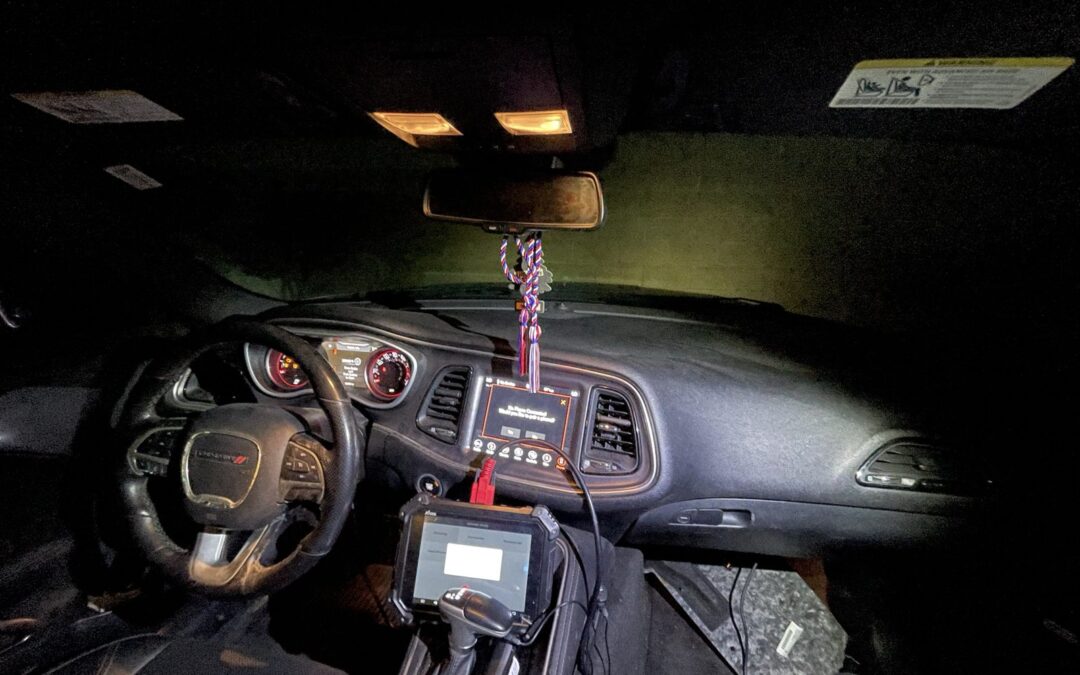
In practice, a technician connects a professional programming tool to the car’s OBD port, the diagnostic connector under the dashboard that every modern vehicle has. Through that port, the tool talks to the immobilizer module and walks it through a key-learning process. Which steps the car requires, and how much security it puts in the way, depends on the make, model and year.
Remote and Fob Functions Are Programmed Separately
The transponder chip and the remote buttons are two different systems. The chip lets the car start. The remote transmitter, which handles lock, unlock, trunk and panic, talks to a separate receiver in the car and is registered on its own.
This surprises many people. A key can start the car but have dead buttons, or the buttons can work while the car refuses to start. When we supply a key with a remote, we program both the chip and the remote functions and test each one before we leave. The details of what comes in each key style are covered in our guide to the seven different car key types.
Adding a Key vs. All Keys Lost
The job looks quite different depending on whether you still have a working key.
Adding a spare when you have a working key
This is the simpler case. The car already recognizes an existing key, so the process is usually a matter of connecting the tool, authorizing the session, and registering the new chip alongside the old one. It is also the easiest time to get a spare made, because nothing is urgent and nothing has to be recovered.
When all keys are lost
With no working key, the car has nothing to authorize the process. The tool has to put the vehicle into a key-learning state on its own, and on many models that step is protected. Some manufacturers require a security PIN or access code before they will accept a new key. That code is tied to the vehicle’s VIN and has to be retrieved through an authorized channel, which is why we ask for proof of ownership. Certain Nissan and Hyundai/Kia models are common examples. If you drive one of these, see our Nissan key replacement or Hyundai and Kia key replacement pages for what applies to those brands.
Depending on the car, an all-keys-lost job can also include erasing the old, lost keys from the car so they stop working. That is a good thing: if someone found your missing key, it should no longer start your car.
Smart Keys and Push-Button Start
Proximity keys, the kind that let you keep the fob in your pocket and start the car with a button, work on the same principle but with more going on. The fob uses a low-frequency link to the car for authentication and a radio link for the remote functions, and the car has to be taught to recognize the fob through its security system. These systems tend to be more sensitive to using the right hardware, and some require a PIN or secure data access before a new fob is accepted.
If your car has a start button, your fob is almost certainly one of these. Tell us that when you call; it helps us arrive with the right equipment. Our car key replacement page covers the key styles we work with, and our brand pages for Toyota, Ford, Chevy and GMC and Jeep, Dodge, Chrysler and Ram go into brand-specific details.
Why the “Free DIY Programming” Tricks Often Fall Short
Some vehicles do allow certain functions to be learned from inside the car without a tool. That is real, and it is where the online tutorials come from. But there are several problems with treating it as a general solution:
- It works on a minority of cars. Most vehicles with an immobilizer do not allow a new chip to be registered this way. The procedure that works on one model and year does nothing on the next.
- It often covers only the remote buttons. Learning the lock and unlock buttons is not the same as registering the transponder chip. You can end up with a fob that unlocks the doors and a car that still will not start.
- It still needs a working key on many models. The tricks usually assume you already have a key. They do not help in an all-keys-lost situation.
- The wrong procedure can cause trouble. Repeating steps meant for a different model can lock out the learning mode for a period of time or leave the system in a confusing state.
We are not saying the tricks never work. We are saying they depend on the exact car, and they do not replace a proper key-learning session on the cars that need one.
The Risk With Low-Priced Online Fobs
Ordering a key or fob from an online marketplace looks like an easy way to save money, and sometimes it works out. The problems we see most often:
- Wrong chip or frequency. Listings are often vague about which year range and which chip type the key uses. A fob that looks identical can contain a different transponder or transmit on a different frequency.
- Units that cannot be programmed. Some are locked to another vehicle or are simply defective. A locksmith cannot make them work, and by then the money is spent.
- No warranty and no recourse. If the key fails after a week, there is usually no one to go back to.
We use both OEM and aftermarket keys, depending on the car and what suits the customer. We carry common keys in the van and order the rest as needed, so we are matching the key to your car rather than hoping a generic one fits. Keys and remotes we supply carry a 3-month warranty. That warranty covers the key or remote itself, not the programming. If you already bought a key online, call us before you pay for anything; we will tell you honestly whether it is likely to work.
Dealer vs. Mobile Locksmith
A dealer can do the job, and for some situations that is a reasonable choice. The tradeoffs are mostly logistical:
- Dealer: if you have lost every key, the car usually has to be towed in, and you work around the service department’s appointment schedule. Parts may need to be ordered first.
- Mobile locksmith: we come to your home, workplace or wherever the car is parked. Most car key jobs take under an hour on site, and the car never has to move.
We are a NASTF member and a registered VSP (Vehicle Security Professional), which gives us access to secure vehicle data for models that require it. That access comes with checks: for these jobs we confirm that you are the owner before a key is made. It protects you as much as anyone, because it means a stranger cannot walk up and get a key to your car.
We serve Phoenix, Scottsdale, Tempe, Mesa, Chandler, Glendale, Peoria and Paradise Valley.
What to Have Ready When You Call
A few details let us tell you quickly whether we can do the job and what it involves:
- Year, make and model of the vehicle.
- The VIN. You can read it through the windshield at the lower corner on the driver’s side, or on the label on the driver’s door jamb.
- Proof of ownership. A photo ID and the vehicle registration, with names that match. Some models require both.
- What you have now. Do you have one working key, a broken one, or none? Is it a regular key or a push-button start fob?
- Where the car is. Your location helps us plan the trip.
With those answers, we can usually tell you on the phone what is involved before we set out.
Need a car key made or programmed? Call (602) 301-5243 and we will come to you anywhere in the Phoenix area. You can also see everything we do on our car key replacement page.