Every week somebody in the Valley stands in front of a lock box that won’t open. A realtor box on a front door with the wrong code. A wall-mounted key safe at a short-term rental where the guest got four digits instead of five. A combination cash box in a church office whose treasurer moved to Oregon. A little fireproof document box in a closet, found while cleaning out a parent’s house, key long gone.
Most of what you’ll find online about this is advice on how to shim, pick or drill the thing. We don’t publish that, and not because it’s a secret. It’s because it usually doesn’t work on a decent box, it often wrecks the box or the door it’s on, and if the box isn’t yours it’s a crime. What follows is what actually gets a lock box open, in the order we’d try it ourselves.
First, which kind of lock box is it?
The fix depends on the box, so start by naming it.
Realtor and contractor key boxes. The grey or black pushbutton box hanging on a door handle. Older ones (Supra, MasterLock, Vault Locks) use a mechanical 4-digit code. The blue Supra iBox used by Arizona agents is electronic and opens only with an agent’s app or keypad fob. There is no code to guess on an iBox, and we won’t open one without the listing agent on the phone.
Wall-mounted key safes. The pushbutton box screwed next to a front door at a vacation rental, an elderly parent’s home or a small office. Mechanical pushbutton (Kidde, MasterLock 5401) or a dial. Codes are set by the owner and are often changed by a cleaner or property manager without telling everyone.
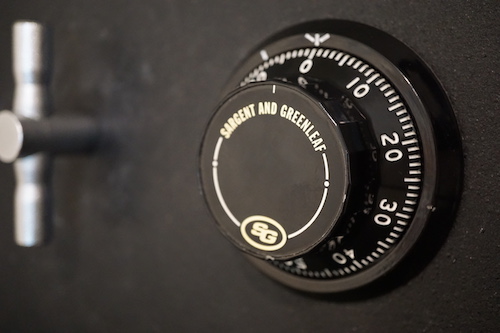
Cash boxes, document boxes and small safes. The grey steel box with a tiny keyed cam lock, the SentrySafe with a key and a dial, the hotel-style safe with a keypad. These are the ones people inherit, find in storage units, or buy at an estate sale with no key.
Gate and pedestrian-gate pushbutton locks. Technically not a box, but the same calls come in. If your problem is a Simplex-style lock on an iron gate, see our page on Simplex pushbutton lock repair.
What to try before you call anyone
These are the things that solve the problem for roughly half the people who phone us.
Try the code the right way. On mechanical pushbutton boxes the order of the digits doesn’t matter, but every button has to be pressed firmly and the box has to be cleared first: press the clear or reset bar (or turn the knob the wrong way) before entering the code. If someone pressed a wrong button a minute ago, the code won’t take until it’s cleared. On dial boxes, three turns one way, two the other, one back — and stop exactly on each number. People pass the number by a tick and assume the box is broken.
Try the factory code. A surprising number of wall key safes and cash boxes have never had their code changed. The factory default is printed in the manual and usually on the manufacturer’s site. Most are 0000, 1234 or, on pushbutton boxes, no buttons at all — just turn the knob. It takes thirty seconds to check and it’s the single most common “fix.”
Call the person who set it. For a realtor box, that’s the listing agent. For a rental, the host or property manager. For a church or club cash box, whoever had the job before. A text usually beats any tool.
Check whether it’s the box or the door. Twice a month we get a “lock box won’t open” call that turns out to be a lock box that opened fine — the key inside just doesn’t fit the door anymore because the locks were rekeyed. If the box opens and the key doesn’t work, that’s a rekey or a lockout, not a lock box problem.
For a keyed cash or document box, look for the key number. Many small boxes have a code stamped on the lock face or the key, such as “SL405” or a three- or four-digit number. With that number a locksmith can cut a key without opening the box, often from stock in the van. It’s the cheapest route there is.
What not to do
Don’t drill it. On a realtor box you’ll be paying the brokerage for a replacement. On a wall key safe you’ll be replacing the safe and probably patching stucco. On a cash box you may drill straight through what’s inside. And a drilled box is not weather-tight or secure afterward, so it’s a one-time win at best.
Don’t pry it. Lock boxes are made to resist exactly that, and the first thing that gives is usually the door handle or the wall anchor, not the box.
Don’t trust the video trick. The shim and “bump” videos are shot on the cheapest boxes money can buy. On anything better, the pushbutton mechanism and the shackle are built to defeat the trick, and you’ll bend the box’s internals trying. We open a fair number of boxes that someone has already “tried something” on, and it’s always harder and costs more.
Don’t open a box that isn’t yours. That includes a realtor box on a house you’re buying and a key safe at a rental you’ve checked out of. We ask for proof of ownership or a call from the owner on every lock box and safe job, and so does any legitimate locksmith.
What a locksmith actually does
Lock boxes and small safes are a normal part of our day, and the methods are the same ones the manufacturers use.
Decoding. On most mechanical pushbutton boxes we can read the combination without damage, reset it to one you choose, and leave you with a working box. On dial boxes we manipulate the dial to find the combination. Either way the box goes back into service.
Key by code or impressioning. For keyed cash boxes, document boxes and desk-style safes, we cut a key from the lock’s code or fit one to the lock on the spot. You get a working key and an intact box.
Non-destructive opening. When a mechanism is actually broken — a snapped spring, a jammed wheel, an electronic safe with a dead keypad — we open it the way the maker designed it to be serviced, which usually leaves it repairable.
Replacement. If a box is beyond saving, or it’s a cheap one you shouldn’t be trusting with house keys anyway, we carry wall key safes and can fit one while we’re there. For rentals and care homes we usually recommend a keypad lock on the door instead of a key safe next to it; see keypad and smart lock installation.
Larger safes — gun safes, floor safes, commercial safes, and government container locks — are their own trade. We do those too; details are on our safe locksmith page.
What it costs and how long it takes
We give the price on the phone before we drive out, and that price is what you pay. The call is cheaper if you can tell us the brand and model of the box and send a photo, because then we arrive with the right parts and don’t need a second trip. Most lock box and small-safe jobs take well under an hour on site. Cash or card; card payments carry a 4% fee. We’re available Monday to Friday, 8:30am to 6pm, across Phoenix, Scottsdale, Tempe, Mesa, Chandler, Glendale and the rest of the Valley.
Lock box FAQ
Can you open a realtor lock box?
A mechanical one, yes, with the listing agent’s authorization. An electronic Supra iBox, no — those are controlled by the MLS, and the agent needs to call Supra support.
Can you figure out the code on a key safe without damaging it?
On most mechanical pushbutton and dial key safes, yes. We decode it, reset it to a new code, and the box stays in service.
I found a locked cash box with no key. Can you make one?
Usually. If the lock has a code number, we can cut a key from it; if not, we fit a key to the lock. Bring the box to the van or we come to you.
Do I need to prove the box is mine?
Yes. ID and something tying you to the box or the property it’s on, or a call from the owner. It protects you as much as it protects us.
Is it worth repairing a lock box or should I replace it?
If the box is a good one, open and reset it. If it’s a $15 box guarding a house key, the honest answer is to replace it with a better key safe or, better still, a keypad lock on the door, so there’s no key outside the house at all.
Lock box, key safe or small safe that won’t open? Call (602) 301-5243. You’ll talk to the locksmith who does the work, and you’ll have a price before we leave the shop.