
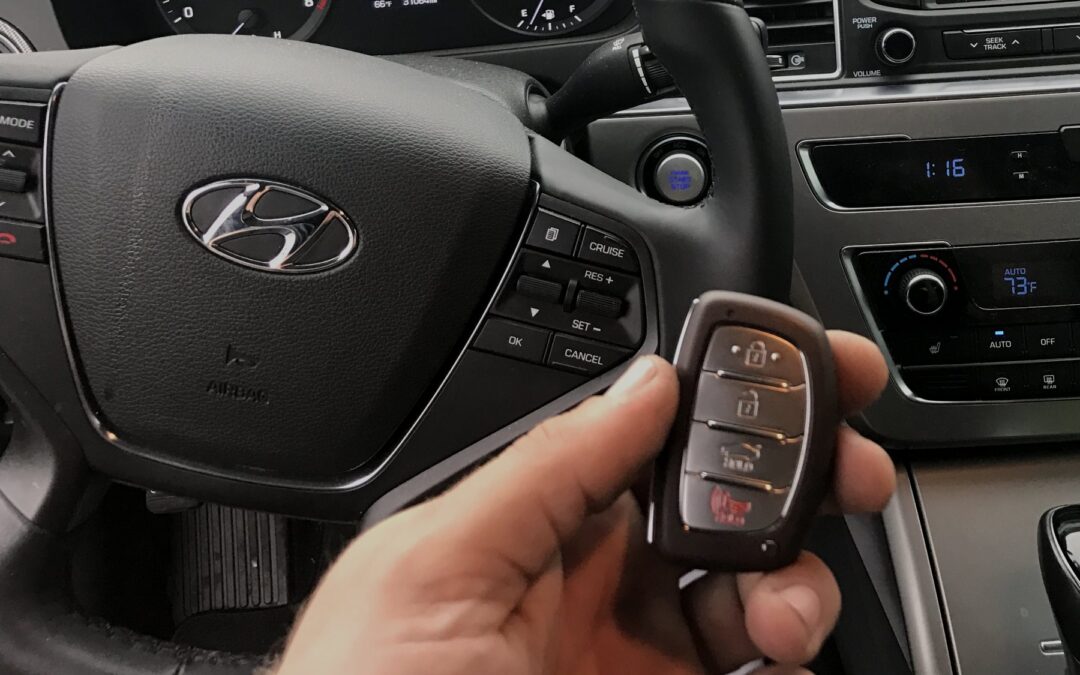
Nearly every car key replacement call starts with the same question from us: “What does your key look like?” The answer decides almost everything that follows: whether the key can be cut in a minute or needs to be programmed to the car, whether we can do it at the curb or the car has to see a dealer, and what it costs. This guide walks through the seven kinds of car key on the road today, how to tell which one you have, and what replacing each one actually involves, based on what we see every week on key calls across Phoenix and the East Valley.
1. Plain mechanical keys
What it is: an all-metal key, or metal with a thin plastic head and nothing inside it. It works purely by its cut: the ridges along the edge lift pins or wafers in the lock. No chip, no battery, no electronics.
Which cars: most vehicles built before the late 1990s, many base-model trucks and work vans into the early 2000s, and some older imports. If your car starts with a key you could copy at a hardware store, it’s this.
Replacing it: the simplest case. With a working key, it’s a duplicate. With no key at all, a key is made to the door or ignition lock, or cut from the key code the manufacturer stamped on the lock or recorded against the VIN. Either way, no programming, done in one visit.
2. Transponder (chip) keys
What it is: a metal blade with a thick plastic head that hides a tiny glass or ceramic chip. When you turn the key, the car’s immobilizer reads the chip’s code; no matching code, no start. The blade alone will turn the ignition and crank the engine, but the engine won’t run.
Which cars: almost everything from about 1998 onward. Toyota, Honda, Nissan, Ford, Chevy, Hyundai and Kia all moved to chip keys in that window, and a plain-looking key on a 2005 Camry or 2010 F-150 almost certainly has a chip inside.
Replacing it: two steps. The blade is cut, then the chip is programmed to the car through the diagnostic port. With one working key some makes allow a quick copy; with no keys at all the car has to be put into programming mode and taught a new key, which is where a mobile locksmith earns the call. Some manufacturers (Nissan and some Hyundai/Kia models, for example) require a security code pulled from the VIN. We do that from the van.
How to tell: thick plastic head, and a small key-shaped or padlock light on the dash that goes out when a correct key is in. If your blade turns and the engine cranks but won’t fire, and that light stays on or blinks, the chip isn’t being read.
3. Remote-head keys
What it is: a transponder key with lock, unlock and sometimes panic or trunk buttons built into the head. Two separate systems in one key: the chip starts the car, the buttons talk to the body control module on a radio frequency.
Which cars: most mainstream vehicles from the mid-2000s to the late 2010s: Toyota Corolla and Camry, Honda Civic and Accord, Ford F-150 and Escape, Chevy Silverado and Equinox, Nissan Altima, Hyundai Elantra, Kia Sorento, Jeep Wrangler, Dodge Ram, among many others.
Replacing it: cut, program the chip, and program the remote. On many cars the remote pairs during the same programming session; on some it’s a separate step or a button sequence. If only the buttons have stopped working, it’s usually the battery (a coin cell under the cover) or a worn button pad, not a programming problem. If the car starts but the remote is dead after a battery change, the remote itself has failed and the head gets replaced and re-paired.
4. Flip (switchblade) keys
What it is: a remote-head key where the blade folds into the fob and springs out at the press of a button. Functionally identical to a remote-head key; the difference is the mechanism and the fact that the blade is a separate part that can be swapped.
Which cars: common on Ford (Fusion, Focus, later F-150), Chevy and GMC (Cruze, Malibu, Silverado), Hyundai and Kia (Sonata, Optima, Soul), Jeep, Dodge and Chrysler (Grand Cherokee, Charger, 300), and Nissan.
Replacing it: same as a remote-head key. One extra thing we see constantly on these: the hinge wears and the blade wobbles or won’t lock out. A fresh blade can often be fitted to the existing fob without reprogramming anything.
5. Smart keys (proximity fobs)
What it is: a fob that stays in your pocket. The car senses it nearby, unlocks when you touch the handle, and starts with a push button. Inside is a transponder chip, a radio transmitter, and a battery. Almost all of them also hide a small emergency blade for the driver’s door in case the fob battery dies.
Which cars: standard on most new vehicles for the past several years, and on higher trims going back to the late 2000s: Toyota Prius, RAV4, Highlander; Honda CR-V, Accord, Pilot; Nissan Rogue, Altima, Pathfinder; Ford Explorer, Escape, F-150; Chevy Tahoe, Traverse; Hyundai Tucson, Santa Fe; Kia Telluride, Sportage; Jeep Grand Cherokee; Ram 1500; and so on.
Replacing it: programming only, since the blade is usually cut just for the door. Most Toyota, Honda, Nissan, Ford, Chevy, Hyundai, Kia and Chrysler-family smart keys can be programmed at the car by a locksmith with the right equipment, including all-keys-lost. Some late-model systems are locked down to the dealer; we’ll tell you on the phone by year and model. The fob itself is the expensive part, and it pays to ask whether an aftermarket or refurbished fob is an option for your car.
“Key not detected” on the dash is almost always a dead fob battery. Hold the fob against the start button (or the spot in the manual) and push; most cars will start that way long enough to get you to a battery.
6. Laser-cut (sidewinder) keys
What it is: not a different electronics type but a different blade: thick, with a wavy groove milled into the flat face instead of ridges on the edge. Cut on a specialized machine. Usually paired with a chip or remote head, and found on most smart-key emergency blades.
Which cars: Honda and Acura, Toyota and Lexus, Ford from roughly 2011 on, GM from the mid-2000s on, many Hyundai and Kia, Nissan Infiniti models, Jeep and Chrysler products.
Replacing it: the hardware store can’t cut these, which is why people end up at the dealer. A locksmith with a laser-cutting machine can, from a working key or from code, on site. The chip or remote is then handled as above.
7. Tibbe and other oddballs
A handful of keys don’t fit the categories above. The Tibbe key is a round, notched key used on some older Ford products; it needs a particular machine and a particular blank, but it’s a plain mechanical key underneath. Older GM cars used VATS keys with a small resistor pellet in the blade that the car measures; not a chip, but the resistance has to match. Some fleet trucks and vans use plain double-sided keys with a chip added later. If your key looks unusual, send us a photo and we’ll tell you what it is.
Quick guide: which key do you have?
Metal or thin plastic head, no buttons: plain mechanical (older car) or a chip key (anything from about 1998 on; check for a security light on the dash). Buttons on the head, blade fixed: remote-head key. Blade folds into the fob: flip key. No blade, push-button start: smart key. Groove milled into the face of the blade: laser-cut blade, paired with any of the above. Still not sure? The year, make and model nearly always tells us.
What it costs to replace, in order
From least to most: a plain key with a working original; a plain key with no original; a chip key duplicate; a chip key all-keys-lost; a remote-head or flip key; a smart key. Laser-cut blades add a little to any of those. Dealer prices run higher for everything with a chip, partly because the dealer can’t come to you and partly because dealer fobs are OEM-only. We quote on the phone by year, make and model, and the price we quote is the price. See the make pages for typical ranges: Toyota, Ford, Chevy & GMC, Nissan, Hyundai & Kia and Jeep, Dodge, Chrysler & Ram.
Three things every car owner should do
Have a second key. Every category above is cheaper to duplicate than to replace from nothing, and on some cars a spare is the difference between a twenty-minute visit and an ordered part. If you have one key, make the second one now.
Know where the emergency blade is. On a smart key, find the release catch and try it once at home, and find the hidden keyhole on the driver’s door (often under a cap at the end of the handle). The day you need it will be a bad day to learn.
Replace fob batteries before they die. If you’re pressing the button twice, or standing closer to the car than you used to, the battery is going. They cost a few dollars.
Car key FAQ
Can a locksmith really program my key, or do I need the dealer?
For most Toyota, Honda, Nissan, Ford, Chevy, GMC, Hyundai, Kia, Jeep, Dodge, Chrysler and Ram models, yes, at your car, including when every key is lost. A small number of new models are dealer-only; we’ll say so when you call.
Will the hardware-store copy start my car?
Only if it’s a plain mechanical key. A copy of a chip key will open the doors and turn the ignition but won’t start the engine until the chip is programmed.
My key was stolen. Can the old one be disabled?
Yes. On chip and smart-key cars we can erase all the keys the car knows and program only the new ones, so the stolen key no longer starts it.
Can you make a key for my car if I lost the only one?
Yes. That’s most of what we do. Have the registration or title and your ID ready; we won’t make a key to a car without proof it’s yours.
What about motorcycle keys?
Different animal; see our motorcycle key guide. And for a look at house, padlock and other key types, see every type of key explained.
Need a car key made or replaced? Call (602) 301-5243 with the year, make and model. We’ll tell you which kind of key it is, whether we can do it on the spot, and what it costs. Details on our car key replacement page.
Desert Locksmith is an owner-operated mobile locksmith in Phoenix, AZ, Monday to Friday, 8:30 to 6.