
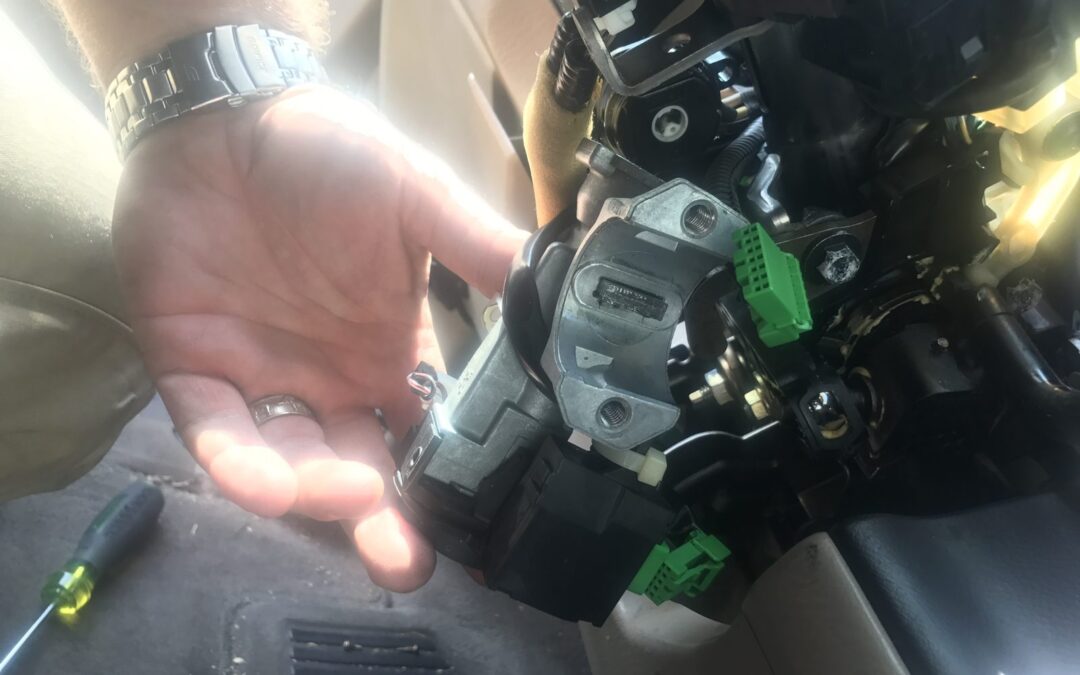
You slide the key in, turn it, and nothing happens. The key won’t move, or it moves a hair and stops. It’s a frustrating way to start the day, and a call we get often across the Phoenix metro. The good news is that a key that won’t turn is often caused by something simple. The bad news is that the wrong reaction, usually forcing the key, can turn a small problem into a broken key stuck in the cylinder.
This guide covers the real causes, what is safe to try yourself, the signs that the ignition cylinder itself is wearing out, and when it’s time to have a locksmith come to you.
Why a Car Key Won’t Turn
The key turns a cylinder full of small pins or wafers. Every one of them has to line up with the cuts on your key before the cylinder is free to rotate. Anything that disturbs that match, or adds extra resistance, leaves you with a key that won’t turn. These are the causes we see most often.
The steering wheel lock is binding
When you turn off the engine and turn the wheel, a steering lock pin engages. If the front wheels were turned against a curb, or you leaned on the wheel while getting out, that pin can be under pressure. The ignition cylinder can’t rotate while the pin is loaded, so the key feels completely stuck. This is the cause behind a lot of “my key won’t turn” calls, and it is also the easiest one to fix.
A worn or bent key
Keys wear down with years of use. The cuts round off, and the key no longer lifts the pins or wafers to the exact height they need. A key that has been bent, even slightly, from being used as a pry bar or sitting in a back pocket, can have the same effect. If the key has started to feel “sticky” going in or coming out, or you have to jiggle it to start the car, wear is the likely cause.
A poorly cut duplicate
Copies made from copies drift further from the original with each generation. A duplicate cut on a worn machine, or traced from a worn key, may look right but sit a fraction off. It may work in the door and fail in the ignition, or work for a few weeks and then stop. If your spare key turns smoothly and the other one doesn’t, that tells you a lot.
Debris or a worn ignition cylinder
Lint, dust, and fine grit collect in the ignition over the years, especially with a loaded keychain hanging off it. Inside, the wafers and springs wear too. Once they do, the cylinder can bind, turn only in certain positions, or stop turning altogether. This is the “mechanical” failure that actually needs repair.
The shifter isn’t fully in Park
Most automatic vehicles have an interlock that keeps the key from turning to the off or lock position unless the shifter is fully in Park, and keeps the car from starting unless it is in Park or Neutral. If the lever is resting just short of Park, the key can refuse to turn. Some push-button and electronic shifters also depend on battery power to release the interlock.
A weak or dead battery
On many newer vehicles, the interlock is electronically controlled. A weak battery can leave it stuck, so the key feels locked even though nothing is wrong with the key or the cylinder. If your dash lights are dim or the car clicks when you try to start it, check the battery before anything else.
Extreme temperatures
Here in Arizona, heat is the bigger factor. Metal expands, and a cylinder that has been baking in a parked car can feel tighter than usual, particularly if it is already worn. A key that sticks in the afternoon and works fine in the morning is a classic sign of a cylinder on its way out.
Safe Things to Try First
These are all gentle, and none of them can hurt the car. If any step needs more than light pressure, stop.
- Wiggle the steering wheel gently. Hold light turning pressure on the key and rock the steering wheel slightly left and right at the same time. If the steering lock was binding, the key should release.
- Check Park (or Neutral). Press the brake, move the shifter out of Park and firmly back into it. For a manual transmission, make sure it is in Neutral and press the clutch.
- Try your spare key. If the spare turns easily, the problem is the original key, not the cylinder. If neither key turns, the cylinder or the interlock is the more likely culprit.
- Compare the two keys. Hold them side by side. Look for rounded cuts, bends, or a visible difference in the cut pattern. Don’t keep using a damaged key, since it can wear the cylinder.
- Take extra weight off the keychain. A heavy bundle of keys hangs on the cylinder and adds side pressure. Remove the other keys and try again.
- Check the battery. If the dash is dim or the car is clicking, a jump start or battery replacement may be all you need.
- Use a dry lubricant if the lock feels gritty. A dry graphite lubricant or a lock-specific product is the general recommendation. Avoid oil-based sprays like WD-40 in an ignition or door lock. They attract dust, gum up over time, and make the next problem worse.
What Not to Do
The single most expensive mistake is forcing it. Do not use pliers, a wrench, or a hammer on the key, and do not lean your weight into it. Keys are brass or nickel-silver and they snap. A key broken off in the ignition means extraction, and in many cases a new cylinder, instead of what could have been a simple adjustment.
Also avoid spraying unknown products into the cylinder and taking the steering column apart yourself. On modern vehicles the ignition is connected to the immobilizer and key-recognition system, and a DIY mistake can leave you with a car that won’t start even with the right key.
Signs Your Ignition Cylinder Is Failing
If the simple fixes didn’t help, or the problem keeps coming back, the cylinder is probably wearing out. Watch for these:
- The key works only if you jiggle it, or it turns in some positions and not others.
- The key goes in with resistance, or comes out with difficulty.
- The key won’t turn on any key you own, original or spare.
- The car starts intermittently, or the dash lights flicker while the key is in the start position.
- The key doesn’t return from the start position, or it feels loose and sloppy.
- The problem gets worse with heat or after the car has been sitting.
A failing ignition cylinder doesn’t fix itself. It tends to get worse, usually at the least convenient time. We do ignition repair on many makes, Hondas included. See our Honda ignition repair page for how that process works.
What a Locksmith Does On Site
We are mobile, so we come to your home, workplace, or wherever the car is parked in Phoenix, Scottsdale, Tempe, Mesa, Chandler, Glendale, Peoria, and Paradise Valley. Depending on what we find, the job usually falls into one of these:
- Diagnose the cause. We check the key, the cylinder, the steering lock, and the interlock to figure out which is actually at fault, so you don’t pay for a repair you don’t need.
- Extract a broken key. If part of the key is stuck in the cylinder, we remove it without damaging the ignition when possible.
- Repair or replace the ignition cylinder. A worn cylinder can often be repaired, and when it can’t, we replace it and set it up to work with your key.
- Cut and program a new key. If the original key is the problem, we cut a fresh key by code or from the vehicle, and program it where the car requires it. Keys and remotes we supply carry a 3-month warranty.
- Rekey the ignition. If the cylinder is in good shape but you want the ignition matched to a new key, for example after losing keys, we can rekey it.
Most car key jobs take under an hour on site. We do ask for ID, and for proof of ownership such as registration, before making or programming keys for a vehicle.
Which Key Do You Have?
The fix depends partly on the kind of key. A basic metal key, a transponder key with a chip, and a laser-cut key all behave differently when something goes wrong. Our guide to 7 different car key types explains how to tell which one you have, which helps when you call. We also have pages for the brands we see most often: Toyota, Ford, Chevy and GMC, Nissan, Hyundai and Kia, and Jeep, Dodge, Chrysler and Ram.
When to Call
Call us if the gentle steps above don’t free the key, if the key is bent or cracked, if part of it has broken off in the lock, or if the problem keeps returning. Stopping early is far better than forcing the key and dealing with the damage afterward.
Need help with a car key that won’t turn? Call (602) 301-5243 and tell us your vehicle and where you are. We’ll let you know what we can do, and you can read more about our car key replacement service.