“How much to rekey my house?” is the question we get most from new homeowners in Phoenix, and the honest answer is that it depends on a handful of things you can count yourself before you call: how many doors, how many separate locks on each door, what brand they are, and whether you want them all on one key. This guide explains how a rekey is priced, what pushes the number up or down, when rekeying is the wrong choice and replacing the lock is cheaper in the long run, and what to expect on the day. By the end you’ll be able to look at your doors and have a good idea of what you’re in for.
Rekeying vs. changing locks, in one paragraph
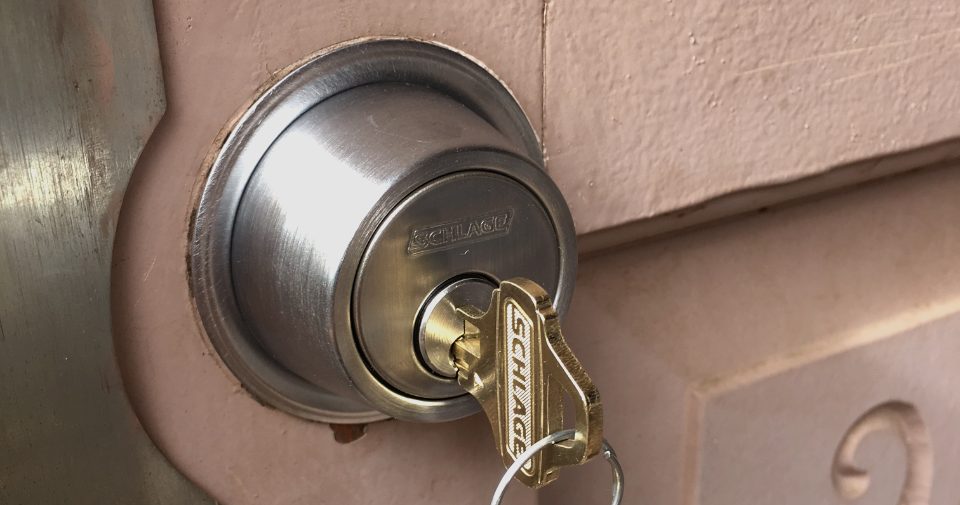
Rekeying keeps your existing locks and changes what’s inside them. The locksmith takes the cylinder out, swaps the small brass pins for a new set matched to a new key, and puts it back. Your old keys stop working, the new ones work, and the hardware on the door is untouched. Changing locks means removing the whole lock and installing new hardware. Rekeying is cheaper because you’re not buying hardware; changing is the right call when the lock is worn, cheap, damaged, or you want a different style or a better grade. Most houses we visit only need a rekey.
How the price is built
Almost every locksmith prices a rekey the same way: a service call (the trip to you, which covers the first bit of work) plus a charge for each lock cylinder rekeyed. A “cylinder” is each separate keyed mechanism, so a front door with a deadbolt and a keyed knob is two cylinders, not one. Then there are extras: making additional copies of the new key, keying several locks alike so one key runs the house, and any repair work the locks turn out to need.
Our numbers, for a typical house: a $75 service call (it varies a little with distance; we ask where you are and quote it on the phone) plus $25 per standard residential lock, which covers most Kwikset, Schlage, Defiant and Weiser knobs, levers and deadbolts. A front door with a deadbolt and a keyed knob is two locks, so $50 plus the call. Commercial hardware, interchangeable-core (IC) locks, an IC core with no control key, high-security cylinders, and any lock we have to rekey without a working key take more time and parts and are quoted separately once we know what’s on the door. Everything is a flat price given before we start.
So the way to estimate your own job is to walk the house and count: every exterior door, and on each one, every keyed lock. A typical Phoenix single-family home has a front door (deadbolt plus knob or lever), a door from the garage into the house, a back or patio door, and sometimes a side gate or casita. That’s usually four to seven locks. Count them: five standard locks is $75 plus $125, or $200 for the house, and adding a sixth is another $25, not another trip.
What makes a rekey cost more
Commercial and interchangeable-core locks. Storefront and office doors often use mortise cylinders, IC (small- or large-format interchangeable core) locks, or restricted keyways. An IC core is fast to swap when the building has its control key; without the control key, or when a core has to be rekeyed without any working key, the job is a different animal and priced on the door, not per the residential rate. We handle these for business owners and property managers and quote once we see the hardware.
Mixed brands. Schlage and Kwikset keys don’t fit each other’s locks. If your front door is Schlage and the back door is Kwikset, they can’t be keyed alike without changing one of them, which means either two keys or a new cylinder. Most tract homes in the Valley are all one brand, but renovations mix them.
High-security and restricted-key locks. Schlage Primus, Medeco, Mul-T-Lock and similar take more time, use special pins, and may need a key blank that only an authorized dealer can supply. Expect these to cost more per cylinder and sometimes to need the right paperwork before anyone will touch them.
Smart locks and keypads. A Kwikset SmartKey or Schlage keypad deadbolt usually still has a conventional cylinder behind the electronics that can be rekeyed; some take a minute, some take disassembly. Kwikset SmartKey locks can be re-set to a new key in seconds with the right tool, which brings the price down.
Locks that need repair. A cylinder that’s been sun-baked for fifteen Phoenix summers, filled with dust, or forced at some point often needs new springs, a new cam, or lubrication while it’s apart. Small, but it adds up over several doors.
Keyed-alike across many locks. Not a big cost, but matching a lot of cylinders to one key takes longer than rekeying each one to whatever is quickest.
Extra keys. You get a couple with the rekey; more than that are charged per key. Tell us up front how many the household needs.
Nights, weekends, and distance. We work Monday to Friday, 8:30am to 6pm, so there’s no after-hours surcharge to worry about with us; some companies charge a lot more outside business hours. Trip charges vary with distance from the locksmith’s base, so a locksmith in Phoenix is cheaper for a Phoenix address than one driving in from Queen Creek.
What makes it cost less
Having every lock on the list ready and the doors accessible. Knowing the brand. Choosing one key for the whole house (fewer key copies to cut, less confusion). Rekeying everything in one visit instead of two. And bundling it with anything else you need, such as a new deadbolt on a door that has none, because the trip charge only happens once.
When replacing is the better buy
Rekeying a bad lock is money spent on a bad lock. We’ll recommend replacing instead of rekeying when: the lock is a builder-grade knob with a loose, wobbly cylinder; a deadbolt bolt only extends half an inch (a good deadbolt throws a full inch into the frame); the lock is so stiff the key bends; a lever or knob is cracked; the finish has corroded badly; or the strike plate and screws are flimsy enough that the lock would give way before the key ever mattered. A quality Grade 2 deadbolt costs less than most people think and lasts decades. On a brand-new house with decent Schlage or Kwikset hardware, rekeying is almost always the right choice.
Who should rekey, and when
Anyone who just bought or moved into a home: the previous owner, their relatives, a cleaner, a contractor and a neighbor all have keys, and you have no way to know how many. Anyone who’s had a roommate, tenant, partner or employee leave with a key. Anyone who’s lost a key ring with an address on it. Landlords between tenants (many Arizona landlords rekey at every turnover, and tenants can ask for it). Anyone who inherited a property. Anyone who simply hasn’t done it in years and has handed out a few too many copies. The job takes under an hour on a typical house.
What happens during the visit
We check each lock, pull the cylinders, pin them to a new key, reinstall and test every door from both sides, and hand you the new keys. If a lock needs repair or can’t be keyed alike with the others, we tell you before we do anything that changes the price. Bring the lock brand and door count when you call and we’ll give you a flat quote on the phone; that number is the number.
Rekeying FAQ
Can I rekey my own locks?
Kwikset SmartKey locks are designed for it, with a learn tool and a new key. Conventional pin-tumbler locks need a pinning kit, a follower, a key gauge and some practice; most people who try it end up with a pile of springs and a locksmith call anyway. For one SmartKey lock, do it yourself. For a whole house, it’s cheaper to have it done than to buy the tools.
Can all my doors be on one key?
Yes, if the locks are the same brand (or compatible keyways). Mixed brands can be made to match by changing a cylinder or two.
Does rekeying work on commercial doors?
Yes, and on master-key systems, where some keys open some doors and one key opens everything. Pricing follows the same logic: per cylinder, plus setup for the system.
How long does it take?
About ten to fifteen minutes per lock. A whole house is usually under an hour.
Do I get new keys?
Yes, a couple with the job, and more cut on the spot at a per-key charge.
Do you rekey smart locks and keypads?
Most of them, yes. The mechanical key cylinder behind the keypad is rekeyed like any other; we’ll also show you how to change the codes while we’re there. See our smart lock installation page if you’re thinking of switching.
Ready to rekey? Count your doors and locks, note the brand, and call (602) 301-5243. We’ll quote it on the phone and come to you anywhere in Phoenix, Scottsdale, Tempe, Mesa, Chandler, Glendale and the rest of the Valley. More on our rekey locks page.