Standing outside your own front door with the keys on the kitchen counter is a universal experience, and the internet’s answer to it is a credit card and a butter knife. Here’s the truth from a locksmith who opens doors in Phoenix every week: the credit card works on almost no exterior door made in the last forty years, the butter knife ruins locks, and the real ways in without damage are quieter, faster and less dramatic than any of that. This guide explains what is actually holding your door shut, what you can try that won’t cost you a lock or a door frame, how a locksmith gets in without a mark, and how to make sure you never read this page again.
What’s actually keeping you out
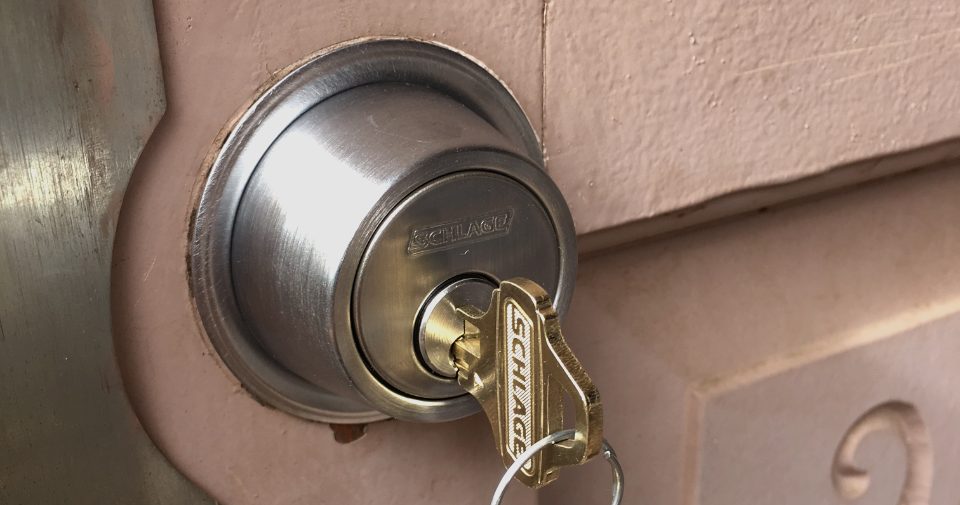
An exterior door typically has two locks. The latch in the knob or lever: a spring-loaded, angled bolt that clicks into the strike plate when the door closes. And the deadbolt: a solid square bolt that only moves when a key or thumb-turn moves it. If only the latch is locked, the door was simply pulled shut behind you. If the deadbolt is thrown, someone turned a key or the inside knob.
The credit card trick, pushing the angled latch back by sliding a card between the door and the frame, is defeated by two things found on nearly every exterior lock: a deadlatch, the small secondary pin beside the main latch that locks the latch solid when the door is closed properly, and the door stop or weather strip that covers the gap. It can still work on an interior door, an old door with a worn strike, or a cheap knob installed badly. On a front door, it does nothing except ruin the card.
A knife or screwdriver in the keyhole doesn’t turn the lock; it bends pins and springs so the lock stops working with its own key, and then you need a new lock as well as a way in. Kicking the door breaks the frame, not the lock, and a door frame repair costs many times what a lockout call does. Taking the hinge pins out only works if the hinges are on the outside, which on an exterior door means it was hung backwards.
Things that are worth trying
Every other door and window, including the one from the garage into the house; a garage keypad if you have one (and the emergency release on the garage door from outside is a locksmith job, not a YouTube one, because it’s the same thing a burglar would do). A family member, roommate, landlord or property manager with a key. A spare you gave a neighbor years ago and forgot. A smart lock’s app or code, if there is one. A sliding glass door that was left unlocked, which is more common than people think and is also a reason to fix it afterward.
If an interior door is the problem (a bedroom or bathroom that locked itself), most have a small hole in the outside knob. A straightened paperclip, a small flat screwdriver or the little key that came with the lock pushes or turns the release. That’s the one case where the DIY advice is right.
How a locksmith opens a locked house without damage
Picking. For most residential knobs and deadbolts (Kwikset, Schlage, Defiant, Weiser and the like), the lock is picked: the pins are set one by one to the same position the key would put them in, and the cylinder turns. It leaves no trace and the lock works normally afterward. Time: a minute or two on most locks, longer on high-security ones.
Bypass. Some locks and situations are opened without touching the cylinder: shimming a latch that has no deadlatch, releasing a lever lock through a specific gap, using a tool under the door on certain handle types. These are judgment calls at the door.
Decoding. Some locks can be read, with the key then cut on the spot, which solves the lockout and the lost-key problem in one visit.
Drilling, as a last resort. High-security cylinders and some smart locks can’t be picked in a reasonable time. Then the cylinder is drilled in a precise spot, the door opened, and the cylinder replaced. We’ll tell you that’s the plan before we start, and it’s rare on a typical home.
Whichever way, you should expect a locksmith to ask for ID showing the address, or something else that proves you live there (a bill inside the house, a lease on your phone, a landlord on the line). We won’t open a home for someone who can’t show they belong in it. That’s your protection too.
Lockouts that are really something else
The key turns but the door won’t open. The latch or bolt is binding in the strike, usually because the door has sagged or swelled (Phoenix monsoon humidity does this to wood doors). Pull or push the door while turning the key. Afterward, the strike plate can be adjusted.
The key goes in but won’t turn. Wrong key, a worn key, or a worn lock. Jiggling helps once; forcing bends the key. If the key snaps, don’t push the piece in; we extract it and cut a new key from the halves.
The key won’t go in. Something is in the keyhole, or a previous broken key is. A locksmith clears it; a flashlight can tell you which.
Smart lock dead. Most keypad deadbolts have a mechanical key as a backup and a 9-volt battery contact on the bottom for emergency power. If you never set up the key, that’s a lockout we open like any other, then we set the key up with you.
After you’re in
If you’re locked out because the keys are lost rather than inside, have the locks rekeyed the same visit: a lost key ring with a house key and anything with your address on it means someone may have both. If it’s the third lockout this year, a keypad deadbolt with a code for each family member ends the problem, and we can install one on the spot. And give a spare to someone you trust, not under the mat, not in the fake rock, not on top of the door frame, which are the three places anyone looking will look first.
House lockout FAQ
Will picking the lock damage it?
No. A properly picked lock works exactly as before. A lock that’s been attacked with a screwdriver or a knife usually doesn’t.
Can you get me in if I don’t have ID on me?
Usually, once the door is open, by showing mail or ID inside the house, or with a landlord or a family member who can vouch for you by phone. We’ll work it out with you, but we won’t skip it.
I’m a tenant. Can I call a locksmith or do I need the landlord?
You can call us; you’ll need to show you live there. Many leases ask you to notify the landlord about lock changes, so rekeying is worth a call to them first; a lockout opening changes nothing.
How fast can you get here?
During business hours, Monday to Friday 8:30am to 6pm, we’ll give you a real arrival time on the phone based on where we are in the Valley, not a promise we can’t keep.
Do you open apartments, condos and gates?
Yes, with the same ID rule. Community gates and building doors are usually the property manager’s call.
Locked out of the house? Call (602) 301-5243, tell us the address and what kind of lock is on the door, and we’ll get you in without a mark anywhere in Phoenix, Scottsdale, Tempe, Mesa, Chandler, Glendale and the rest of the Valley. More on our residential locksmith page, and on rekeying if the keys are gone for good.