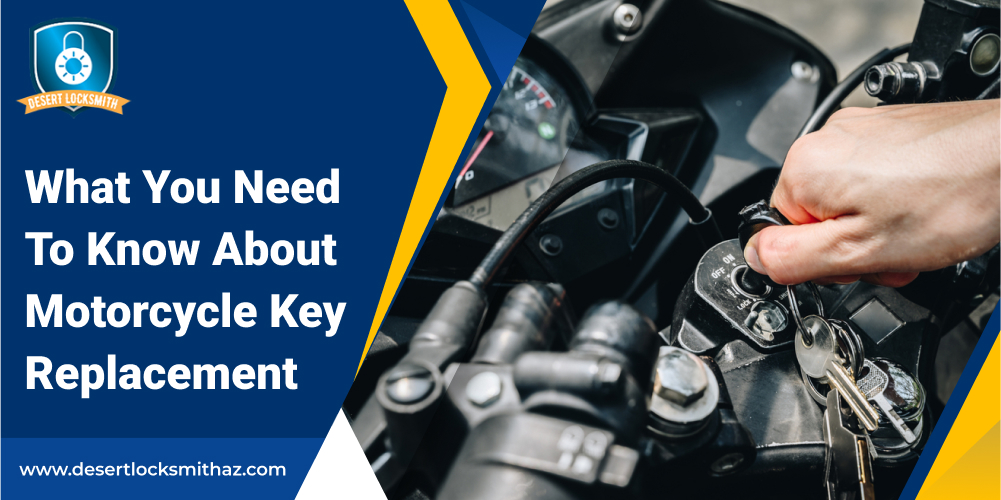
A lost motorcycle key is a different problem from a lost car key, and most of the advice online treats them as the same thing. On a bike the ignition is small and exposed, the key often runs three or four other locks, the dealer answer usually involves a new ignition and a trailer, and on anything built in the last fifteen years there’s a good chance the key has a chip talking to an immobilizer. This guide covers what we actually run into on motorcycle key calls across Phoenix and the Valley: what kind of key your bike has, what it takes to replace it, what you need to have ready, and when the dealer really is the right call.
One thing up front: motorcycle keys are a small part of our work, and some bikes need parts we have to order. If you call, we’ll tell you on the phone whether it’s a same-day job, an order-and-come-back job, or a dealer job. We’d rather say so than waste your afternoon.
The three kinds of motorcycle key
Plain metal keys. No chip, no electronics. Most bikes built before the mid-2000s, nearly all Harley-Davidsons (the barrel-style tubular key on older models, the flat key on newer ones), most dirt bikes and dual-sports, scooters, and many cruisers. If your bike starts with a plain key and you’ve lost it, this is the easiest case: a key can be made to the ignition or to another lock on the bike, and the ignition stays.
Transponder (chip) keys. A plastic-headed key with a chip the bike reads before it will start. Honda calls its system HISS (a small key-shaped light on the dash). Yamaha, Kawasaki and Suzuki have their own immobilizers, mostly on sport bikes and larger touring models from the mid-2000s onward. The blade can be cut, but the bike won’t run until a key with the right chip is programmed to it. How that’s done varies a lot by brand and year: some can be programmed through the diagnostic port, some need an existing key to learn a new one, and some are locked so tightly that the only route is a new ECU-and-key set from the dealer.
Proximity fobs. The newest bikes and scooters (some Honda Gold Wings, Indian, Harley’s security models, many maxi-scooters) start with a fob in your pocket. Lost fobs on these are almost always ordered through the dealer and paired by them.
How to tell what you have
Look at the head of your key: all metal, or thin plastic with nothing inside, means a plain key. Thick plastic, often with the maker’s logo, means a chip. Look at the dash when you turn the key on: a blinking key-shaped or padlock light that goes out when the correct key is in means an immobilizer. Check your owner’s manual for a “key registration” or “immobilizer” section. And look at the key tag you got with the bike: a lot of manufacturers stamp a key code on it, and that code lets a locksmith cut a key without the original.
What replacing a motorcycle key involves
If you still have one working key: this is the cheap version and the reason we tell every rider to get a spare now. A plain key is cut from your key. A chip key is cut and, depending on the bike, cloned from your key or registered with the bike. Either way it’s usually a quick visit.
All keys lost, plain key: we read the lock and cut a key to it, or cut from the key code on your tag or in the dealer’s records. On most bikes the ignition, gas cap, seat lock and helmet lock are keyed alike, so one new key opens everything. When the ignition has been tampered with, or someone has already tried to force it, it may need to be replaced; we’ll tell you that before we start.
All keys lost, chip key: the blade is the easy part. The programming is the question, and we answer it on the phone by make, model and year before we quote. Honda HISS bikes of certain years, for example, can be done at the bike; others require the dealer to order a matched key set. If a bike is one we can’t program, we’ll say so rather than take the call.
Broken key in the ignition: we extract the piece without damaging the lock, then cut a new key from the two halves. Don’t try to pull it with pliers; a broken piece pushed deeper usually means a new ignition.
Ignition rekey or replacement: if you bought a used bike and want the previous owner’s keys dead, or the ignition is worn or damaged, the cylinder can be rekeyed or replaced and the other locks matched to it.
Gas caps, seat locks, saddlebags and helmet locks
These are small locks and they fail or lose keys constantly. Most can be keyed to match your ignition key so you carry one key. Saddlebag and top-case locks on touring bikes, and the locking gas caps on cruisers, are usually simple cam locks we can fit a key to on the spot. Harley tour-pak and saddlebag locks are a common call.
What you need to have ready
Proof of ownership, every time. The registration or title in your name, plus photo ID. The VIN on the frame should match. We don’t make keys to bikes without it, and you should be suspicious of anyone who will, because the same person would make a key to your bike for someone else. If the bike is at a storage unit, a friend’s garage or a repair shop, that’s fine, as long as the paperwork is in order and you’re there.
Also useful: the key tag or code if you have it, the year, make and model, and a photo of the key if you have one at all. With those we can usually bring the right blank the first time.
Locksmith or dealer?
Go to the dealer when the bike uses a proximity fob, when it’s a late-model immobilizer bike that needs a matched ECU-and-key set, or when the bike is under warranty and you want everything on the record. Go with a locksmith when it’s a plain key, a broken key, a gas cap or bag lock, a used-bike rekey, or a chip-key bike that can be programmed on site — because the alternative is trailering the bike in, paying for a new ignition and matched locks, and waiting for parts. We’ll tell you which category you’re in on the phone.
Cost and timing
Price depends on whether you have a working key, whether the key has a chip, and whether the ignition needs work. We quote it on the phone and that’s the price. Plain-key jobs are typically done in one visit; chip-key jobs sometimes need a blank ordered first. Cash or card, with a 4% fee on cards. Monday to Friday, 8:30am to 6pm, across Phoenix, Scottsdale, Tempe, Mesa, Chandler, Glendale and the rest of the Valley.
Motorcycle key FAQ
Can you make a motorcycle key without the original?
For plain keys, yes, from the ignition or another lock, or from the key code. For chip keys it depends on the make and year; call with the details and we’ll tell you.
Do you make Harley-Davidson keys?
Yes, both the older tubular-style keys and the newer flat keys, and we can rekey the ignition and bag locks to match. Harley fob-based security systems are a dealer item.
My key turns but the bike won’t start and a light is blinking. What is it?
The immobilizer isn’t recognizing the key’s chip. Either the chip has failed or the key was never registered. The fix is programming, not another cut key.
Can you come to where the bike is?
Yes. Everything is done at the bike from the van, anywhere in the Valley.
I bought a used bike with one key. Should I do anything?
Get a spare made now while you have a key to copy; a lost-key job costs more. If you don’t know who else has keys, rekey the ignition.
Lost or broken motorcycle key? Call (602) 301-5243 with the year, make and model. We’ll tell you straight away whether it’s a job we can do on the spot, and what it costs. More on our motorcycle locksmith page.
Desert Locksmith is an owner-operated locksmith in Phoenix serving the whole Valley.