
You press the button and nothing happens. No chirp, no click of the locks, no flash of the lights. A car remote that stops working is one of the most common calls we get, and the good news is that the cause is usually simple. Below are the reasons a key fob quits, in roughly the order we see them in the field around Phoenix, what you can safely try yourself, and when it is time to call a mobile locksmith.
The Most Likely Causes, in Order
1. A dead or weak battery
This is the cause far more often than anything else. Fobs run on a small coin-style battery that slowly loses strength. The first sign is usually reduced range: you used to unlock the car from the front door and now you have to be standing next to it. Then you need several presses per command, and eventually nothing works at all.
Replacing it is normally simple. Most fobs have a small slot in the shell where you pop the case open, swap the battery, and snap it closed. The battery type is printed on the old battery. Check the battery orientation before closing the case. On most vehicles the fob keeps its programming through a battery change, so it should work immediately. If it does not, one of the causes below is likely.
2. Worn buttons or a cracked shell
Fobs that have lived on a key ring for years take a beating. The rubber button pads wear through, the printed symbols disappear, and the plastic cracks around the key ring hole. When the pad wears down, the button no longer presses firmly on the contact beneath it, so some buttons work and others do not.
If the electronics inside are healthy, this is often fixable without buying a new remote. The board can be moved into a fresh shell, or the worn contacts can be cleaned or repaired. We check this first before suggesting a replacement.
3. The fob lost sync with the car
Remotes and cars communicate using coded signals that have to match. If the fob was pressed many times out of range of the car, if the car battery was disconnected or went dead, or if a battery change was interrupted, the two can fall out of step. Some vehicles let you resynchronize with a short sequence, and others need a programming tool.
Reprogramming fixes this when the remote itself is in good condition. We carry the programming equipment to do it at your location for most makes and models.
4. Heat and water damage
Phoenix is hard on electronics. A parked car in July can reach interior temperatures far beyond what a fob was designed to sit in, and fobs left on a dashboard, in a cup holder, or in direct sun suffer for it. Heat can warp the plastic, weaken solder joints, and shorten battery life. If your fob stopped working during or right after a stretch of summer heat, this is a real suspect.
Water is the other one: a fob that went through the wash, got dropped in a pool, or sat in a wet pocket. Corrosion builds on the board and the battery contacts, sometimes days after the water exposure. If a fob gets wet, open it up, remove the battery, and let it dry completely before trying anything else. Do not use a hair dryer or leave it in a hot car to speed things up.
5. A damaged board or chip
Drops, impacts, and age can crack the circuit board or damage the transponder chip inside. A fob with a damaged board may work intermittently, work only when held a certain way, or die completely. These cases usually mean replacing the remote rather than repairing it.
6. A problem on the car side
Sometimes the fob is fine. A weak car battery can cause the receiver to behave erratically, with dim interior lights, slow cranking, and a remote that works only some of the time. In push-to-start vehicles, a weak car battery can also trigger warnings about the key not being detected. A faulty receiver, antenna, or fuse can also be the cause. A quick test is to try your spare fob. If the spare works normally, the problem is almost certainly with the first fob. If neither fob works, look at the car.
7. Aftermarket fob quality
Not every replacement remote is built the same. Some low-grade aftermarket fobs from online marketplaces have weak transmitters, poor battery contacts, or shells that fall apart, and some stop working within months of being programmed. We use both OEM and quality aftermarket remotes, and we choose based on the vehicle and what makes sense for the customer. If your current remote came from an unknown online seller and has been unreliable from day one, replacing it with a better one is often the right fix.
Quick Things You Can Safely Try
Before you call anyone, a few checks take a couple of minutes and cost little or nothing:
- Try the spare fob. This tells you right away whether the problem is the fob or the car.
- Replace the battery. Use the exact battery type printed on the old one. Check that it sits flat and the contacts are touching it.
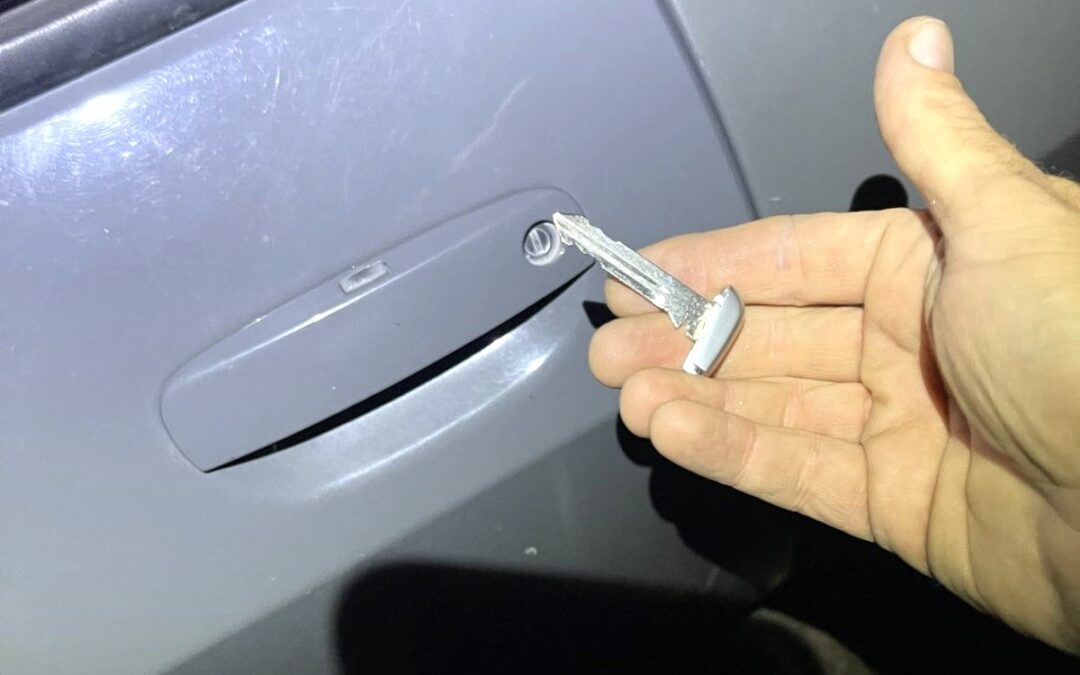
- Use the physical key. Most fobs contain a mechanical key blade that releases from the case. It will open the driver door and keep you from being stranded. On many push-to-start vehicles, holding the fob against the start button or the spot marked on the steering column lets the car read the chip even when the fob battery is dead. Your owner’s manual shows where that spot is.
- Check the car battery. Dim dome lights, a slow crank, or clicking on start all point to the car battery rather than the remote.
If a new battery and a different location do not help, stop there. Repeatedly pressing buttons or trying random online programming procedures can make a sync problem worse, and forcing a cracked case open can damage the board.
When to Stop and Call a Locksmith
Call us if any of these apply:
- A new battery did not bring the remote back.
- The fob has been dropped, soaked, or cooked in the heat.
- Both fobs have stopped working.
- You are down to your last working fob. Do not wait for it to fail. Making a spare while you still have one working fob is faster and simpler than starting from nothing.
What We Do When We Arrive
We come to you, at home, at work, or in a parking lot. The process is straightforward:
- Test the fob. We confirm whether the remote is transmitting and whether the car is receiving it, which separates a fob problem from a vehicle problem.
- Battery and contacts. We replace the battery if needed and check the contacts for corrosion or wear.
- Repair or replace. If the board is healthy and only the shell or buttons are worn, we can often repair it. If the board or chip is damaged, we recommend a replacement.
- Program on site. We program the new or existing remote to your car. For most makes, this is done right at your vehicle, and most jobs take under an hour on site.
We need to confirm ownership before programming a key for a vehicle, so have your ID and registration ready. Remotes we supply carry a 3-month warranty. The programming itself is not covered by a separate warranty claim.
Replace It or Reprogram It?
The question we answer most often is whether the existing fob can be saved. A simple rule of thumb:
- Reprogramming or a battery change is enough when the fob lights up, is physically intact, and the car simply stopped responding.
- Repair is a good option when the problem is limited to the shell, button pads, or battery contacts.
- Replacement is the right call when the board is cracked, there is corrosion damage, the transponder chip has failed, or the fob keeps failing after repair.
The right remote depends on the vehicle. Fobs vary widely between a basic remote, a remote head key, a flip key, and a push-to-start smart key. Our guide to the 7 different car key types explains the differences. If you drive one of these makes, we have pages with details on each: Toyota, Ford, Chevy and GMC, Nissan, Hyundai and Kia, and Jeep, Dodge, Chrysler and Ram. If your Honda starts but the key will not turn smoothly, that is a separate problem, covered under Honda ignition repair.
Dealer vs. Mobile Locksmith
A dealer can program a remote, but the process usually means getting the car to the dealership, scheduling an appointment, and sometimes waiting for a part to be ordered. If you have lost every key, the car may need to be towed in. A mobile locksmith comes to the car, so there is no tow, no trip, and no lost workday. We carry many remotes in the van and order the rest, and we program most makes. A quick call with your year, make, and model tells you whether we can help.
Need a key fob fixed or replaced? Call (602) 301-5243 and tell us the year, make, and model. We serve Phoenix, Scottsdale, Tempe, Mesa, Chandler, Glendale, Peoria, and Paradise Valley, and we will tell you what the job involves before we head out. You can also read more about our car key replacement service.