Rekey the locks you have, or buy new ones? Both stop old keys from working, and for most houses in Phoenix the cheaper one is also the right one. But not always. This guide explains what each option really changes, the situations where rekeying is plenty, the ones where new hardware is worth paying for, and a quick test you can run at your own front door.
What each one actually changes
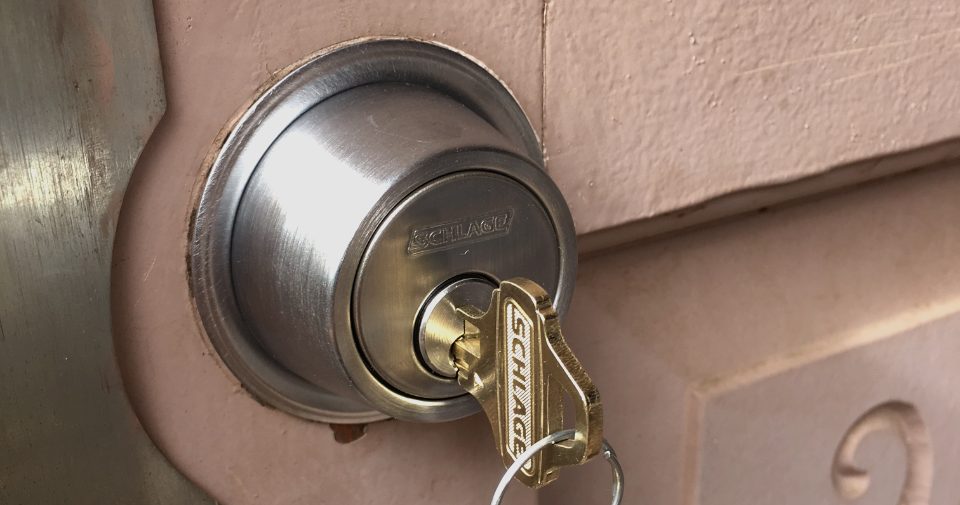
Rekeying keeps your lock and changes what’s inside it. We take the cylinder out, swap the small pins for a set that matches a new key, and put it back. Your old keys no longer turn it and the new ones do. The hardware on the door is the same hardware, just with a new key.
Replacing means removing the whole lock and installing a new one. You get new hardware and a new key, and you can choose a different grade, finish or type, such as a keypad or smart lock.
Neither one makes a door stronger by itself. A rekeyed lock is exactly as secure as it was before, and a new lock is only as secure as its quality and how well it’s installed.
Rekey when
- You just moved in. You don’t know who has copies of the old keys, and the locks themselves are fine. See our new home lock checklist.
- A key was lost or stolen. The lock is sound; the missing key is the problem.
- A tenant, roommate, contractor or ex-partner moves out. Rekeying between occupants is quick and keeps landlords from tracking dozens of old keys.
- You want every door on one key. Same-brand locks can all be keyed alike, and mixed brands can be matched.
- The locks are decent and working. A Kwikset, Schlage, Defiant or Weiser lock in good shape rarely needs replacing just because the keys are out there.
Replace when
- The lock is worn or failing. The key sticks, the knob wobbles, the latch doesn’t catch, or the deadbolt has to be forced. Rekeying a bad lock gives you a bad lock with new keys.
- It’s low-grade hardware. Thin builder-grade locks are a weak point. If the lock is the weakest part of the door, a better one makes a real difference.
- The door has been forced. After an attempted break-in, the lock, strike plate and frame may all be damaged. Replace what’s damaged and reinforce the strike.
- You want something new. A keypad, a smart lock or a different style means new hardware. See our smart lock installation page.
- The lock can’t be rekeyed sensibly. A few sealed or heavily worn locks cost about as much to rekey as to swap.
A quick test at your own door
Stand at the front door and ask three things. Does the key turn smoothly, and does the deadbolt throw all the way into the frame? Does the lock sit tight on the door without wobbling? Do you want any feature you don’t have today? Three yeses to the first two and a no to the third means rekey. A no on either of the first two, or a yes on the third, means replace that lock. Most houses end up as a mix: rekey the good ones, replace the one that’s worn out.
What rekeying doesn’t fix
Rekeying changes keys, not the door. A weak frame, a short strike-plate screw, a glass panel next to the deadbolt or a gap at the latch will still be there afterward. When we’re at the house, we look at the doors as well as the locks and tell you what’s worth fixing.
How the cost compares
Our rekey price is a $75 service call (varies a little with distance) plus $25 to $40 per lock, depending on the lock. Most standard knobs, levers and deadbolts are $25. New hardware costs more per lock and the price depends on the grade and style you choose, so we quote replacements after seeing the doors. For rekey pricing in detail, see how much it costs to rekey a house.
Rekey or replace FAQ
Is a rekeyed lock as secure as a new one?
It’s as secure as it was before. Rekeying fixes “who has a key,” not the quality of the lock.
Can you rekey if I’ve lost every key?
Yes. A lock with no working key takes more time and is quoted separately.
Can all my locks be keyed the same?
Yes, if they’re the same brand or a compatible keyway. We can match mixed brands by changing a cylinder or two.
Do I have to replace a smart lock to change who has access?
No. Change the codes, and rekey the key cylinder behind the keypad like any other lock.
Not sure which one you need? Call (602) 301-5243, tell us how many doors and what brand the locks are, and we’ll tell you what we’d do. We come to you in Phoenix, Scottsdale, Tempe, Mesa, Chandler, Glendale and the rest of the Valley. More on our rekey locks page.