
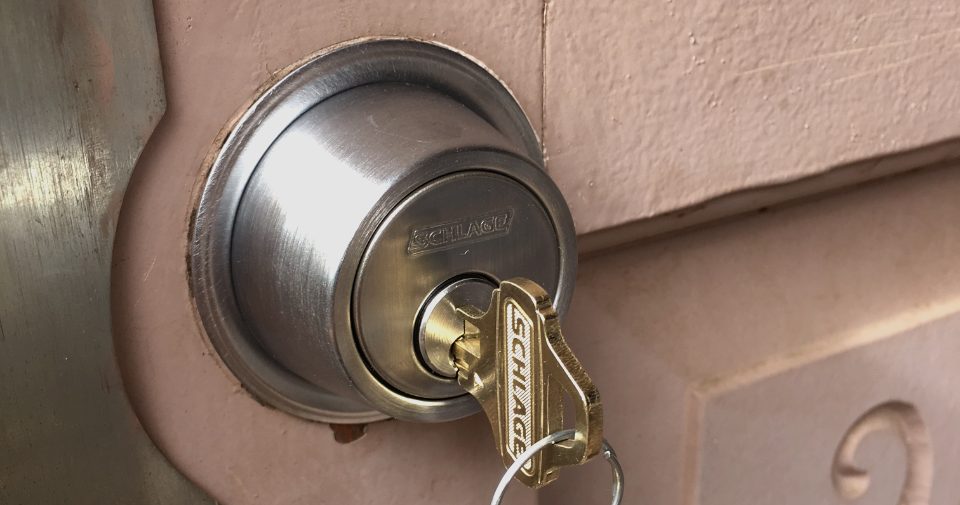
Rekeying sounds like it must involve replacing the lock, and it doesn’t. It’s a short job done on the lock’s cylinder, and once you see what’s inside, it’s easy to understand why the old keys stop working. This is a plain-English walk through what a locksmith actually does, how long it takes, and what can and can’t be rekeyed.
A pin-tumbler lock in thirty seconds
Most house locks, knobs and deadbolts are pin-tumbler locks. Inside the cylinder is a round plug that turns when you turn the key. A row of tiny spring-loaded stacks sits above it, and each stack is made of two pins: a lower pin that touches the key, and an upper pin pushed down by a spring. With no key, the pins straddle the gap between the plug and the housing around it, and that gap is called the shear line. While the pins cross it, the plug can’t turn.
The cuts on a key are different depths on purpose. The right key lifts each lower pin to exactly the right height so the gap between the pins lines up with the shear line. Then nothing crosses it and the plug turns. The wrong key leaves at least one pin out of line, and the lock stays locked.
What happens when we rekey
- Remove the cylinder. We take the lock apart enough to get the cylinder out of the knob or deadbolt. The lock stays on the door for most jobs.
- Hold the pins in place. A tool called a plug follower pushes the plug out while keeping the upper pins and springs in the housing, so nothing scatters.
- Swap the lower pins. We take out the old lower pins and put in a new set sized to match the cuts on the new key.
- Put it back together and test. The plug goes back in, the cylinder goes back in the lock, and we test the new key from both sides of the door.
That’s the whole idea. The cylinder is the same, the lock on the door is the same, and the inside now matches a different key.
Why the old keys stop working
The old key was cut to lift the old lower pins to the right height. After the swap, the lower pins are different sizes, so the old key lifts them to the wrong heights and the gap never lines up with the shear line. The plug won’t turn. The new key matches the new pins and works.
What about Kwikset SmartKey and other “rekey yourself” locks?
Kwikset’s SmartKey locks are built so the owner can rekey them with a small learn tool and the new key, with no pins to swap. If you have one lock and a spare few minutes, that’s a reasonable do-it-yourself job. For a whole house, or locks from several brands, it’s usually cheaper and faster to have it done.
How long it takes
About ten to fifteen minutes per lock, and a typical house takes under an hour. Having several locks keyed alike so one key opens all of them is done during the same visit. Smart locks and keypads are rekeyed the same way; the key cylinder behind the panel is just another cylinder.
What can’t, or shouldn’t, be rekeyed
Most standard house locks can be rekeyed. A few sealed or heavily worn locks cost about as much to rekey as to replace, and a lock that’s loose, sticky or failing is better swapped than rekeyed, because a new key on a bad lock is still a bad lock. We check each one before we start and tell you which are worth keeping. The full decision is in rekey or replace: how to decide.
What it costs
We charge a $75 service call (varies with distance) plus $25 to $40 per lock, depending on the lock. Most standard knobs, levers and deadbolts are $25. The breakdown, including what costs extra, is in how much it costs to rekey a house. Moving into a new home? Start with our new home lock checklist.
Rekeying FAQ
Do I get new keys?
Yes. A couple come with the job, and more can be cut on the spot at a per-key charge.
Can you rekey a lock if I lost the key?
Yes. It takes more time without a working key and is quoted separately.
Will the new key fit my old lock?
The new key fits the lock after it’s rekeyed. The old key won’t work in it anymore.
Does it work on commercial doors?
Yes, including master-key systems. It’s priced per cylinder plus setup, so we quote it after seeing the doors. See our commercial rekey page.
Want it done? Count your doors and locks and call (602) 301-5243. We come to you in Phoenix, Scottsdale, Tempe, Mesa, Chandler, Glendale and the rest of the Valley. More on our rekey locks page.